
At the Global Refugee Forum in December 2019, a group of actors from government, civil society and the UN came together around a simple but profound pledge: to do more to ensure that displaced children and youth and those living in crisis can access safe and quality education. Just over a year later, on 25 January 2021, the Geneva Global Hub for Education in Emergencies was born. The launch was actually timed to coincide with the International Day of Education on 24 January, but it fell on a Sunday that year – hence the EiE Hub’s official birthday being on the day after.
Located at the heart of International Geneva, the EiE Hub was set up to rally political and financial support for education in emergencies, which had too often been considered an afterthought by both donors and humanitarian actors. Five years later, the EiE Hub has grown to a unique alliance of 62 members from government, the United Nations, civil society, philanthropy, financial institutions and others, which has worked tirelessly to raise the profile of EiE on the international agenda.
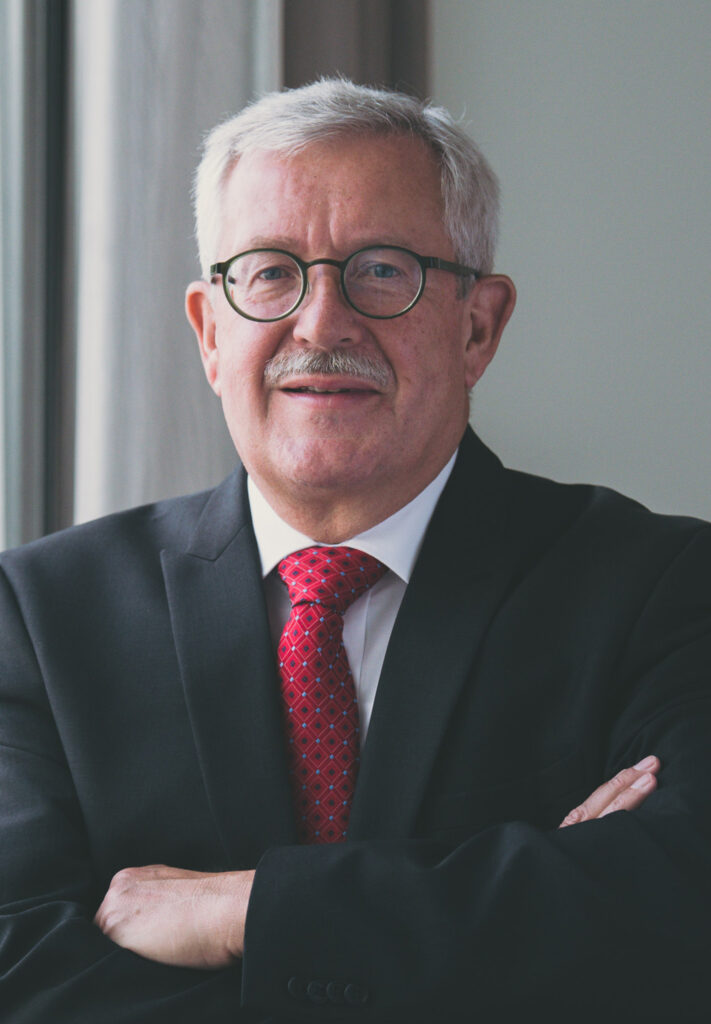
One of those present from the EiE Hub’s early days is Martin Dahinden, a distinguished diplomat who has served as the Director of the Swiss Agency for Development and Cooperation (2008-2014) and Switzerland’s ambassador to the US (2014-2019). Today, he is closely engaged with the EiE Hub and serves as President of the organisation’s legal entity. In this interview, he reflects on the EiE Hub’s origins, future and why it’s still so relevant in today’s turbulent world.
Why was it so important to create the EiE Hub?
In a humanitarian emergency, the focus is usually on protection, nutrition and shelter. This is fine, in principle, as long as emergencies are short-lived. However, over the past few decades, we have seen an increasing number of very long, protracted emergencies. Neglecting education, even in the early days of a crisis, has a serious effect not only on the children and young people concerned, but also on their societies. We often forget that education has multiple positive benefits beyond just schooling – it keeps children safe, and improves access to food, water and other essential services. There is a need to better make this argument to decision makers and practitioners, and raise the profile of education in crisis. The EiE Hub was created to bring diverse actors together to support making this argument.
Why has Switzerland – and you personally – become so committed to education in crisis settings?
Education is key to Swiss society and economy, given that Switzerland is a landlocked country without natural resources. And Geneva is the birthplace and beacon of humanitarian law and action, as well as a center for global governance and an operational hub of multilateral diplomacy. It was therefore a natural location for the EiE Hub. I personally became very familiar with this issue during the pandemic, when I served on the UNICEF Advisory Group, where the issue of interrupted education was regularly discussed.
The EiE Hub was launched in January 2021. How were the early years of the EiE Hub? Any challenges, successes or lessons you want to highlight.
The EiE Hub was intentionally launched with a very lean structure. In my view, this was and is the right thing to do – it helps to keep its budget small and cost effective, but also ensures that the members and their needs drive the EiE Hub’s work. The EiE Hub was very fortunate to have dynamic leadership and staff, some of whom have been with the organisation from the very beginning. This has helped create continuity and to build relationships – crucial in a multilateral setting where cooperation can often make or break any initiative.
The EiE Hub has grown rapidly in both membership and influence over the past five years. How do you see its role today? Why is it still relevant?
This role is still necessary and will remain so in the future. Good coordination, providing a platform for exchange and mutual learning, and drawing attention to education in emergencies, is as important as ever. In today’s challenging financial context, good coordination and ensuring that diverse actors – from UN to philanthropy, from NGOs to financial institutions and governments – can act together in a way that makes them stronger than the sum of their parts is absolutely essential.
You’ve worked at the highest international political level – as Director of SDC and Swiss Ambassador to the US, for example. Has it been difficult to make the case for education’s importance in these fora?
Nobody denies the importance of continuing education, even in the most deplorable circumstances. However, it is difficult to translate this into action. This is precisely why the EiE Hub was created. Geneva is the focus for a lot of high-level decision making: the EiE Hub exists to elevate local voices – through its membership – in these spaces, while ensuring that education is not just included but prioritised on the political agenda.
Funding cuts, global tensions and escalating conflicts – this is a difficult time for the world as a whole, and the humanitarian sector. What do you think the sector’s and education’s approach should be to navigate these challenges?
Progress in almost all areas of humanitarian aid and sustainable development is hampered by funding cuts and political disagreement. However, this is not a reason to slow down. On the contrary, it is an incentive to redouble our efforts and to think of innovative approaches. The EiE Hub provides a platform for such efforts. New actors have chosen the shared office space in Geneva as their headquarters last year, for example, and it’s been inspiring to hear the creative conversations already taking place on how we can face these challenges head-on.
How do you see International Geneva’s role evolving as a global capital for education?
Given the large number of humanitarian organisations in Geneva, it can play an outstanding role in connecting education to humanitarian action. Spreading multilateral activities to many different places is wrong. It would make coordination difficult, less effective and less efficient. Geneva’s role may evolve over the coming years, but it will remain a centre for humanitarian decision-making – it is up to us to ensure that the voices of children and youth are still heard in these spaces.