
Children and young people often bear the brunt of the impacts of humanitarian crises – but there’s still a gap between what they want in interventions and what is actually delivered. On March 11 2026, as part of the Humanitarian Networks and Partnerships Weeks in Geneva, Save the Children, Plan International and the Norwegian Refugee Council (NRC) launched the new report “Put Us at the Centre” – What Children and Young People in Humanitarian Crises Asked For – and the Decisions that Followed. The launch event was also co-organised by the Alliance for Child Protection in Humanitarian Action, the Danish EiE Alliance, the Geneva Global Hub for Education in Emergencies, and the Global Education Cluster (GEC).
Rachel Maher, Accountability for Affected People (AAP) Advisor at UN OCHA, opened the event by stressing OCHA’s efforts to integrate AAP throughout its operations, while acknowledging that there is still more for humanitarian actors to do: “I reject the generality of the idea that the sector is failing on accountability as a whole, but there are things we can do better. A lack of coordination – or even competition – between agencies sometimes means we fall short in our collective approach.”
We then heard from Zeinaba*, a Malian member of Save the Children Denmark’s Adolescent and Youth Advisory Group, who talked about moving beyond consultation to ensure children and young people’s voices are not only heard but genuinely taken into account in decisions that affect them: “I come from a context where [these] decisions have a direct impact on our lives – for example, if a school is opened, or if a health clinic even exists… Young people want to participate in decision-making processes, but there’s no systemic or funded mechanisms to guarantee their involvement.”
Vishna Shah-Little, Director of Child Rights with Save the Children International, then discussed the core of the report’s findings, which are grounded in the lived experiences of children and young people. The study found that children and young people prioritise a core set of interlinked needs that they see as essential to their safety, well-being and futures: education, child protection, food security, livelihoods and participation. The findings also highlight significant gaps between children’s and young people’s priorities in humanitarian settings, and the funding donors provide: “These accountability gaps are structural, they are not due to a lack of consultation. The current funding models do not prioritise the needs of children, leading to their invisibility in funding decisions.”
The next set of speakers addressed good practices in engaging children and youth. Gabriella Harris, working with the GEC, discussed how joint needs assessments provide strategic opportunities to engage children at-scale, while Yehor*, a member of Ukraine Education Cluster’s Children’s Strategic Advisory Group, talked about his own experiences of trying to learn in a conflict zone, where young people’s priorities often centre on mental health support and ways to ensure that education can continue amid air strikes and power outages. Amd Rasho from NRC showed how a youth-led working group of Rohingya refugees had fed into the humanitarian response in Cox’s Bazar.
The event concluded with interventions from young activists and humanitarians, who all shared why meaningful participation in decision-making processes is so important, and how it has helped shape responses in their parts of the world:
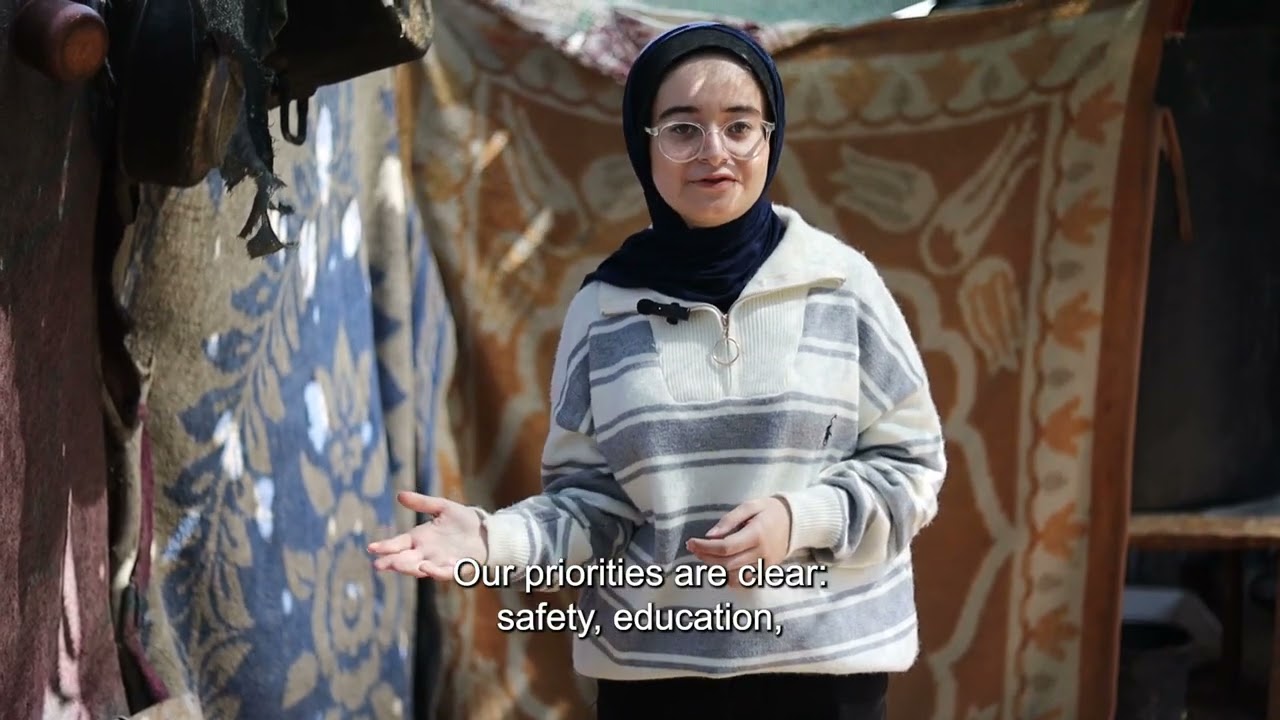
- Tala*, a Human Rights activist from Gaza, talked about situation of young people in Gaza and their dreams and needs for the future.
Tala, 17, on the hopes and education needs of young people in Gaza (produced by Plan International)
- Fatima*, a member of the Plan International Youth Advisory Panel in Nigeria, talked about best practices.
- Pamelah*, a member of of the Plan International Youth Advisory Panel in Uganda, stressed the need for transparency and openness in programming.
- Rowida Tariq, an Education Coordinator in Sudan with NRC, discussed how young people prioritise meeting the needs of their communities, and are often the first line of response in a crisis.
- Hannatu*, a representative from Change the Code in Nigeria, talked about the need for a “power shift” where young people aren’t just consulted but meaningfully involved in decision-making.
To wrap up, Matthias Schmale, UN Resident and Humanitarian Coordinator, Ukraine, dialed in from Kiev to deliver the closing remarks. He acknowledged the courage and resourcefulness of the young activists who had spoken, and challenged humanitarian actors to ensure coherent responses where all actors – practitioners and others – work together: “My own commitment is that tomorrow morning, I will make sure that we do not forget about young people and children as we talk about how can we make them a part of the humanitarian reset. We have to make sure that young people are at the centre of what we do.” He further committed to working to ensure that education remains a priority in the humanitarian space, prioritising youth-led organisations for funding from the Ukraine Humanitarian Fund, and to disaggregate data by age and sex in the next Ukraine Humanitarian National Response Plan.
Read the full report “Put Us at the Centre” – What Children and Young People in Humanitarian Crises Asked For – and the Decisions that Followed.


