
On the occasion of the International Day for the Elimination of Sexual Violence in Conflict, which focused on children affected by conflict-related sexual violence, the Global Survivors Fund (GSF), the Geneva Global Hub for Education in Emergencies (EiE Hub), the Neem Foundation, and partners highlighted the critical role education can play in supporting them. Survivors, practitioners, advocates, and donors explored how education becomes a form of reparation when it supports healing, restores opportunities, strengthens social inclusion, and advances longer-term recovery and reconciliation.
As the number of armed conflicts is at a record high, millions of crisis-affected children face significant barriers to accessing learning. Children affected by conflict-related sexual violence, including rape, sexual slavery, forced prostitution, forced pregnancy, forced abortion, enforced sterilisation, forced marriage and any other form of sexual violence, face particular challenges: for many, leaving school is the norm rather than the exception as they experience the lasting physical, psychological, and social impacts of sexual violence. Children also often face stigma, discrimination, and exclusion within their families and communities.
Education can be a powerful driver of healing and recovery if designed to address the unique needs of children affected by conflict-related sexual violence. To be truly reparative, a supportive school environment must offer a safe space for emotional recovery with trauma-responsive education, flexible enrolment policies, and accelerated education programmes. It can help rebuild emotional stability and confidence and provide protection from further violence and other risks. Education can also act as a restitution by restoring access to schooling that was forcibly interrupted, and as compensation by offsetting the long-term economic damage caused to children affected by conflict-related sexual violence.
Yet, these children have so far remained largely invisible in both education responses and reparation frameworks. This is despite the fact that, under international law, States and other duty-bearers must provide reparation to victims of gross violations of international human rights law and serious violations of international humanitarian law.
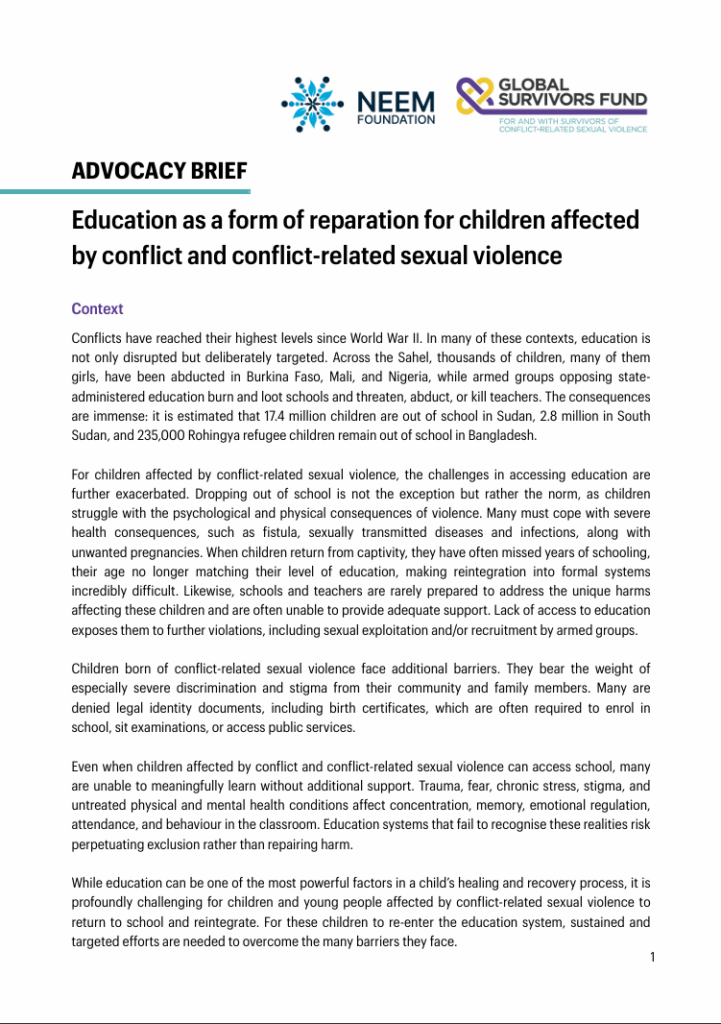
GSF and the Neem Foundation have therefore published an Advocacy Brief calling on stakeholders, particularly States and donors, to explicitly recognise children affected by conflict-related sexual violence as victims eligible for reparation and ensure that reparation programmes are designed to address their specific needs. These should include education as a form of reparation. In this regard, the brief highlights the need to invest in teachers’ trainings and school communities to adopt healing-centred and trauma-responsive approaches, while supporting the scale-up of locally led, survivor-centred education models.
Meaningful progress is possible: in Northeast Nigeria, the Neem Foundation and GSF have partnered to enable children affected by Boko Haram insurgency to return to learning through a flexible, trauma-responsive, and healing-centred accelerated education model. The initiative demonstrates the potential of locally grounded approaches to reach children excluded from education and support their recovery.
Building on this experience, GSF and the Neem Foundation will roll out a multi-country initiative to strengthen the provision of education as a meaningful form of reparation for children affected by conflict-related sexual violence. The EiE Hub will continue to support this agenda by elevating evidence and amplifying the call for education systems to respond to the rights and needs of children affected by conflict.


