

Across the globe, education is increasingly under threat in armed conflict. In 2024, the UN recorded a 44% increase in attacks on schools worldwide, and even this staggering number is likely an underestimate.
It is not just direct attack that threatens the continuity of education during armed conflict, however, but also the military use of schools by parties to the conflict. This can deprive schools of their civilian status, making them vulnerable to attack, while also putting students – particularly children – at risk of injury, recruitment, sexual violence and abduction owing to their proximity to weapon bearers. In 2022 and 2023, the Global Coalition to Protect Education from Attack identified 1,000 instances of the military use of schools and universities in armed conflict, a significant increase on the previous two-year period.
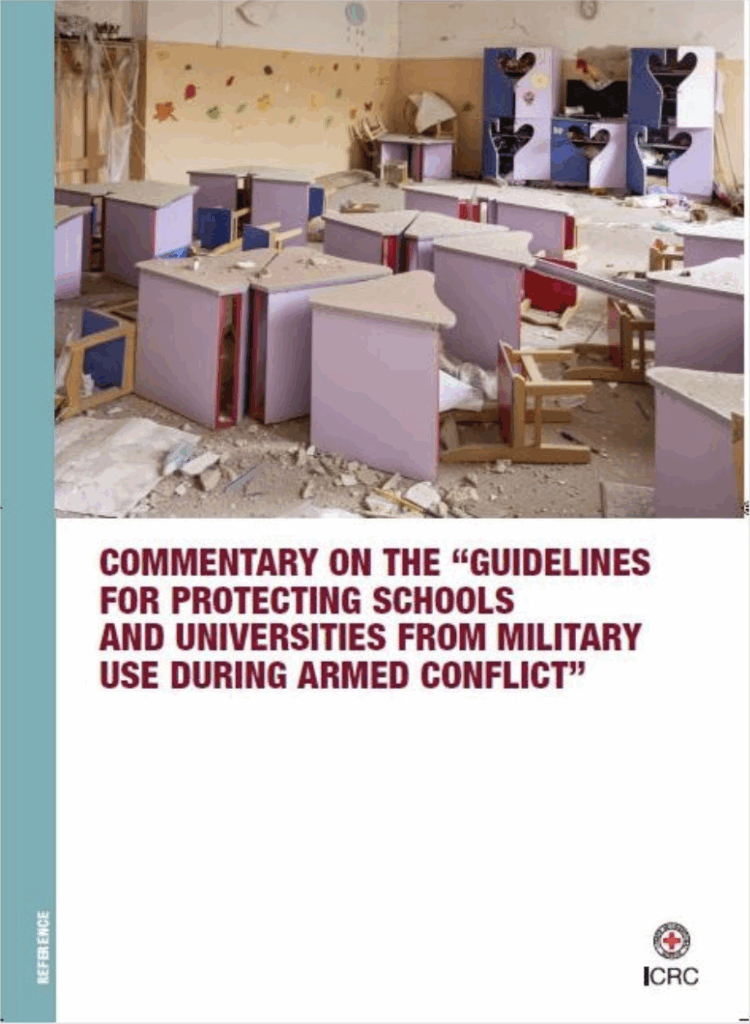
To respond to this urgent reality, the International Committee of the Red Cross (ICRC) on 26 November released a new Commentary on the Guidelines for Protecting Schools and Universities from Military Use During Armed Conflict. The Guidelines themselves, which are associated to the Safe Schools Declaration (SSD), were finalised in 2014, and propose a set of actions that parties to the conflict can take to reduce the military use of schools and universities, and to minimise the negative impact such use may have on students’ safety and education. Since 2015, 122 states have – by endorsing the SSD – committed to “endorse the Guidelines, and bring them into domestic policy and operational frameworks as far as possible and appropriate.”
The Commentary provides the ICRC’s legal interpretation of the Guidelines, with particular emphasis on the links to International Humanitarian Law (IHL) rules governing the conduct of hostilities. Specifically, this Commentary seeks to clarify that, while the Guidelines recommend measures that at times go beyond the requirements of IHL, they remain fully consistent with its provisions, object and purpose. Their implementation can enhance respect for IHL obligations and help prevent future violations. The Commentary was timed to be released on the tenth anniversary of the Safe Schools Declaration, and it was officially launched in Nairobi last week at the Fifth International Conference on the SSD.
The EiE Hub is proud to have worked closely with the ICRC throughout the development of the Commentary, including by administratively hosting the ICRC Legal Advisor leading the drafting process and facilitating engagement with the EiE Hub’s wider membership.


