Country brief: Somalia’s education crisis

Last updated in December 2025
In Somalia, approximately 3.4 million children—58% of school-aged children—were out of school in 2025. On average, Somali children are projected to receive just 1.7 years of schooling in their lifetime, far below the African average of 7.7 years.
Extreme risks from conflict, climate shocks, inequality and poverty erode learning
Somalia faces significant challenges in ensuring safe, uninterrupted access to education, particularly in areas affected by conflict. In 2025, Somalia ranked among the ten countries with the highest numbers of crisis-affected children out of school. Conflict-related disruptions continue to constrain access to education. Throughout 2023-2024, incidents targeting students, teachers and school infrastructure persisted. In the first six months of 2025, attacks on and military use of schools disrupted learning for more than 150,000 children. Rates of grave violations against children remain high, with abductions and forced recruitment affecting predominantly boys and sexual violence disproportionately impacting girls.
Climate-related shocks continue to disrupt education across Somalia. For example, in 2023, floods caused by El Niño displaced an estimated 400,000 children and disrupted learning for nearly 900,000, as schools were damaged or repurposed as shelters. Recurrent drought and famine-like conditions repeatedly force school closures as families migrate for survival. When this happens, children’s education is affected: school attendance rates of newly displaced children are as low as 21%, compared with 39% of non-displaced peers.
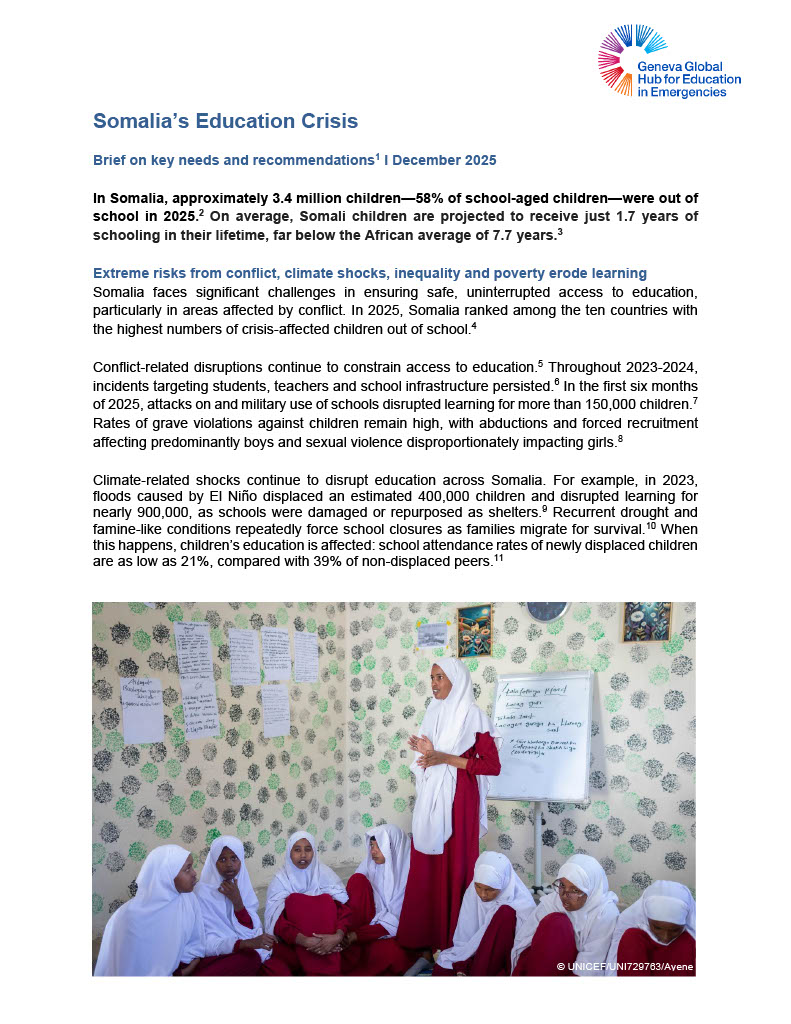
The country exhibits stark geographic and social disparities. While urban households have greater access to education than rural households, only 10% of children from nomadic families attend primary school. The gender gap is also striking: girls are half as likely as boys to complete secondary school, and only 45% of adult women have basic literacy skills, compared to 64% of men. Just 10% of primary teachers are women, severely limiting female role models and safe learning environments for girls. Children with disabilities face additional barriers due to inaccessible facilities, and lack of trained teachers and support services.
Quality education remains severely compromised. Only 36% of primary teachers in Somalia have formal qualifications, and the ratio of pupils per qualified teacher exceeds 100:1 in all Somali schools, reaching nearly 200:1 in some. Overcrowded classrooms, inadequate water and sanitation facilities, as well as weak infrastructure further undermine learning.
The cost of schooling is one of the main barriers to children accessing education. According to the 2023 Somali poverty report, over 54% of the population lives below the poverty line. One study found that an estimated 42.5% of children cannot attend school due to high education costs. In another study, 80% of parents of out-of-school children cited lack of financial resources as the main reason for non-enrollment.
Nearly 19% of children are out of school due to employment or household responsibilities. This is particularly acute for girls who make up more than two-thirds of this group. Four in ten young Somali women are married or in union during childhood, with a significant impact on school enrollment: only 16% of married girls, between the age of 15 to 17, are in school, compared with 40% of girls who were never married or in a union.
Persistently low levels of education in Somalia reinforce cycles of poverty and unemployment, leaving young people with limited livelihood options and increasing vulnerability to negative coping strategies. These education gaps lower human capital, weaken productivity, and slow long-term economic recovery.
Why this crisis is considered neglected
Somalia appears on the 2026 European Civil Protection and Humanitarian Aid Operations list of forgotten crises—severe or protracted emergencies where people receive little or no international assistance, and where political commitment is weak partly due to limited media attention. The Norwegian Refugee Council has ranked Somalia among the ten most neglected displacement crises of 2024, noting negligible media coverage and ineffective political will result in “dangerously low funding levels and constrained humanitarian operations.”
By end of year 2025, only 26% of the USD 1.4 billion UN Humanitarian Needs and Response Plan had been funded, less than half of what was funded in 2024. As a result of severe funding cuts in 2025, education partners reached 87,000 fewer children than in 2024 and closed 477 learning spaces due to reduced capacity. In 2026, humanitarian assistance in Somalia is planned for 2.4 million people, down 47% from 4.57 million in 2025, reflecting a narrower operational scope due to funding cuts, rather than improved conditions.
Less than 0.2% of Somalia’s GDP is spent on public education. Reliance on short-term donor programmes without sustainable domestic financing mechanisms undermines resilience and learning continuity, making the education system highly susceptible to shocks like drastic reductions in international funding. Before 2025, international assistance exceeded government revenue, but this pattern reversed sharply in 2025 as donor funding fell: by mid-year, grants had reached only 16.4 % of their annual target. This created a major budget shortfall and left sectors such as education particularly exposed.
How you can make a difference
Donors and policymakers can take concrete steps that directly address children and youth’s needs in Somalia, supporting education as a life-saving and life-sustaining intervention:
- Bridge the education funding gap, and support local partners
Provide predictable, flexible, multi-year grants to strengthen the education system and support education continuity programmes. Contribute to enhanced coordination between humanitarian and development funding to maximise the impact of limited resources. Support government capacity development, including in leadership, coordination and resource allocation. Channel direct, flexible funding to Somalia’s local NGOs who operate in insecure areas where international organisations’ access is limited. - Protect education from attack and rehabilitate damaged schools
Fund programmes that protect school infrastructure, train students, teachers and communities in conflict-sensitive practices, promote localised protection measures and contingency planning in line with commitments under the Safe Schools Declaration. Invest in programmes to rehabilitate damaged schools, prevent their use by armed actors, and mitigate risks of recruitment and gender based violence in and around learning spaces. Call for the respect of international humanitarian law and international human rights law in the armed conflict, and advocate for the immediate cessation of attacks against and the military use of schools, while supporting calls for accountability for grave violations against children. - Invest in safe, inclusive, and climate resilient education
Invest in safe, inclusive, resilient learning facilities, disaster risk reduction (DRR) measures, DRR education and continuity plans to keep children and youth learning in the face of droughts, floods, and subsequent displacement, in line with recommendations under the Comprehensive School Safety Framework. Fund preparedness and anticipatory action approaches, including early warning systems, that enable proactive responses to climate-related learning disruptions. - Ensure displaced children and youth have access to quality accredited education opportunities
Fund targeted educational programmes and temporary learning spaces for displaced children and youth, with qualified teachers, learning materials, and psychosocial support services. Ensure that the specific needs of children and youth with disabilities are addressed within these approaches, including access to assistive devices, accessible water and sanitation facilities, teacher training in inclusive pedagogy, and community-level mapping of children and youth with disabilities. - Invest in girls’ education and protection
Fund programmes that respond to the specific barriers keeping girls out of school, including lack of female teachers, inadequate sanitation facilities and early marriage.
Non-exhaustive list of local organisations working in Somalia
The organisations listed below were identified in December 2025 with input from EiE Hub members operating in Somalia. Please note that the EiE Hub has not conducted formal vetting or due diligence of these entities. Their inclusion does not imply endorsement or verification. The EiE Hub has not included contact information to avoid providing inaccurate or out-of-date details.
- Himilo Relief and Development Association (HIRDA) is active in the areas of gender-based violence, child protection, water, sanitation, and hygiene, education, food security and livelihoods, health and nutrition.
- Somali Family Service (SFS) addresses critical challenges in governance, peacebuilding, education, and socio-economic development.
- Bay Regional Education Committee (BREC) works in education and related fields.
- Golweyne Relief and Rehabilitation Network (GRRN) focuses on relief and development programmes, including the provision of education.
- Hiran Education Committee (HREC) implements educational programmes.
- Shabelle Education Umbrella (SHEDU) seeks to increase access to primary schools, improve quality education and shape educational policies.
- Somali Society Development Association (SOSDA) provides access to essential services, such as primary education and healthcare.
- Formal Education Network for Primary Schools (FENPS) aims to address the particular needs of vulnerable groups, including providing access to quality education.
- AYUUB NGO (AYUUB) provides children with educational opportunities.
- Puntland Minority Women Development Organisation (PMWDO) focuses on empowering marginalised communities through inclusive programmes in education, health, water, sanitation and hygiene, and protection.
- Nomadic Development Organization (NODO) seeks to support the most vulnerable members of rural communities, including by providing free education and health services.
- Tadamun Social Society (TASS) provides humanitarian assistance and runs primary and secondary schools.
This brief was compiled by the Geneva Global Hub for Education in Emergencies (EiE Hub)’s Technical Working Group, including representatives of Canada, Education Cannot Wait, the Global Education Cluster, the Geneva Graduate Institute/NORRAG, the Inter-agency Network for Education in Emergencies, Save the Children International, Switzerland, UNESCO, UNHCR, UNICEF, the University of Geneva and World Vision International.


