Country brief: Sudan’s Education Crisis

Last updated in February 2026
Sudan is experiencing one of the world’s most critical education emergencies, putting an entire generation’s learning at risk.
A grave assault on children’s rights and an education system under extreme strain
Even before the conflict in Sudan erupted in April 2023, the country’s education system was already fragile, struggling with significant challenges, including low enrollment rates, inadequate school infrastructure, shortages of qualified teachers, and severe underfunding. The conflict further eroded the education system and led to widespread school closures across the country, severely disrupting children’s learning. Six months into the conflict, in October 2023, an estimated 19 million children were out of school and at least 10,400 schools were closed.
While updated estimates indicate that 65% of schools countrywide were open again by January 2026, 7.9 million children remain out of school. Where schools have gradually reopened after months of closure, many still lack basic infrastructure and learning materials.
Conflict and violence have inflicted severe harm on children, teachers and school facilities. Attacks on schools increased fourfold just in the conflict’s first 12 months, with 88 reports of violent incidents. These resulted in the killing and injuring of students and teachers, the torture, killing and abduction of teachers and sexual violence against students inside school facilities. Other incidents included the military use of schools, weapons storage on school grounds and active fighting on school premises. These attacks persist: in December 2025, a nursery and hospital were attacked, killing dozens of children.
Children have also been victims of other grave violations that directly undermine their learning. Notably, in 2023 and 2024, the UN verified the recruitment of 234 children (boys and girls) and incidents of sexual violence against 187 girls, although the real number is likely to be significantly higher because of underreporting. According to experts, survivors of sexual violence in Sudan also face profound barriers to accessing medical and psychological care.
As a result of the conflict, Sudan is facing one of the world’s largest and fastest displacement crises. By December 2025, around 11.8 million people had been forcibly displaced internally and across borders, including into the Central African Republic, Chad, Egypt and South Sudan. Displacement has severely disrupted the education of millions of children, many of which have been displaced multiple times. As one ten-year-old girl who was displaced by conflict explained: “I was hurt to lose a year of school. I missed my friends and my classroom so much. I don’t want any more wars. I just want to wear my backpack every morning and go learn new things”.
Since the conflict erupted, many schools have also been turned into shelters, further undermining the continuity of education. Additionally, some schools in host communities have been significantly strained in space and have faced overcrowded classrooms, leading to double shifts to accommodate larger groups of students.
In addition to conflict and displacement, harsh climate conditions further jeopardise children and youth’s education. In 2024, record global temperatures triggered a severe heatwave that affected millions of children in Sudan and forced reopened schools to close again. “I wish the temperature would drop so I could go back to school,” a 10-year-old displaced boy said.
Sudan is also facing one of the world’s worst hunger crises, primarily driven by conflict. As of November 2025, famine has been confirmed in El Fasher and Kadugli, with 20 additional localities at high risk, and verified reports indicate rising child mortality linked to starvation and lack of essential services. Nutritional deficiencies caused by this famine are likely to impair children’s brain development and impact their learning ability and school readiness.
Economic hardship is another obstacle to learning. As more than 70% of Sudanese families live in poverty and inflation is surging, many cannot afford to send their children to school. Teachers have also been facing significant economic challenges: already among the lowest-paid professionals, many have received partial or no payment at all since the conflict erupted, severely affecting teacher retention.
Even when children go to school, quality of learning remains a challenge. Learning outcomes in Sudan were critically low even before the conflict: according to the 2018 National Learning Assessment, only 2% of Grade 3 learners were able to read fluently in Arabic and 39% were not able to read at all. Limited updated data is available, but small-scale assessments have shown significant gaps in basic reading and mathematics. By early 2025, over a million students had missed critical exams, disrupting their academic progress.
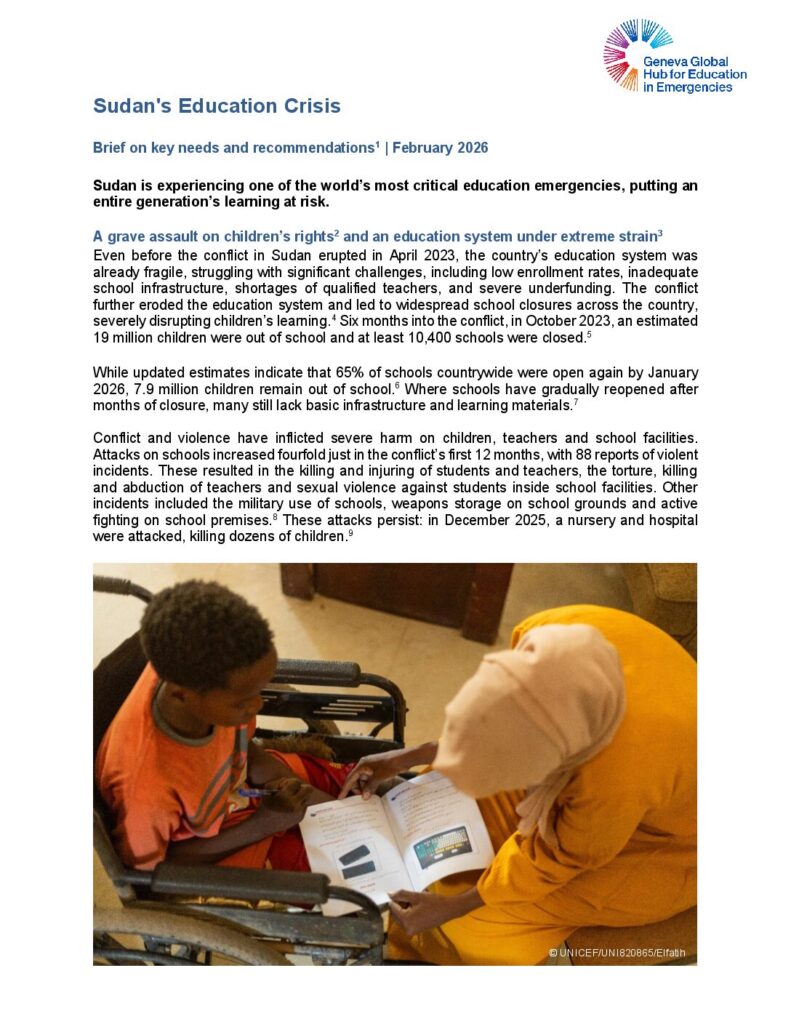
In this harsh context for learning and despite inclusion efforts, children with disabilities remain particularly marginalised, due to disability-stigma, limited physical access to schools and lack of teacher training on how to meet these children’s special needs.
Why this crisis is considered neglected
Despite the scale of the crisis, Sudan has been overshadowed by other major conflicts in both media coverage and donor attention. At the start of 2024, media coverage of Sudan averaged 600 new articles per month, compared with more than 100,000 on Gaza and Ukraine. In June 2025, humanitarian actors were forced to reduce their funding request for education in Sudan by 90% amid sweeping cuts to foreign aid. By end of 2025, the UN education response for Sudan faced a funding gap of USD 37.3 million, while the overall Sudan humanitarian response plan was only covered by 38.6%, falling short of USD 2.55 billion.
How you can make a difference
Donors and policymakers can take decisive steps that directly address children and youth’s needs in Sudan, supporting education as a life-saving and life-sustaining intervention:
1. Bridge the education funding gap, and support teachers and local partners
Provide predictable, flexible, multi-year grants to reinforce the education system, support education continuity and accelerated learning programmes. Contribute to enhancing coordination across humanitarian and development funding to maximise the impact of limited resources. Strengthen education system capacity, governance, coordination for crisis-resilient service delivery. Contribute to improving teachers’ conditions, advocating for regular and timely payment of salaries, incentive mechanisms and continued capacity-building. Channel direct, flexible funding to Sudan’s local NGOs, community-based education initiatives, and grassroots solutions.
2. Protect education from attack and address conflict-driven school closures
Fund programmes that protect school infrastructure, train students, teachers and communities in conflict-sensitive practices, promote localised protection measures and contingency planning in line with commitments under the Safe Schools Declaration. Invest in programmes to rehabilitate damaged schools and prevent their use by armed actors. Call for the respect of international humanitarian law and international human rights law in the armed conflict, advocate for the immediate cessation of attacks on education, and support calls for accountability for grave violations against children.
3. Support psychosocial programming and school feeding programmes
Prioritise and fund psychosocial support in all education and child protection programmes, including safe spaces, trained school-based counsellors and community-led peer support groups, to help children and youth experiencing severe emotional distress cope, and experience a sense of normalcy and safety. Scale up school feeding programmes that can reduce child malnutrition while providing a strong incentive for enrollment and regular attendance, particularly in high-risk and displacement-affected areas.
4. Ensure displaced and most vulnerable children and youth have access to quality education opportunities
Fund targeted educational programmes and temporary learning spaces for displaced children and youth. Ensure that girls, children with disabilities, and those in hard-to-reach areas have access to quality education opportunities, as per the Transitional Education Plan 2025-2027 (TEP).
5. Invest in safe, inclusive, climate-resilient education
Invest in safe, inclusive and resilient learning facilities to withstand increasingly extreme weather events. Fund disaster-risk reduction (DRR) measures, DRR education and education continuity plans that keep all children and youth learning in the face of disasters, in line with recommendations under the Comprehensive School Safety Framework (CSSF). Fund preparedness and anticipatory approaches, including early warning systems, that enable proactive responses to climate-related disruptions. Invest in climate and green skills education to empower children, youth and teachers as agents of change for resilience and climate action.
Non-exhaustive list of local organisations working in Sudan
The organisations listed below were identified in January 2026 with input from EiE Hub members operating in Sudan. Please note that the EiE Hub has not conducted formal vetting or due diligence of these entities. Their inclusion does not imply endorsement or verification. The EiE Hub has not included contact information to avoid providing inaccurate or out-of-date details.
- African Vision For Development Organization (AVDO)
- Alnahda Organization For Peace And Development (Al Nahda)
- Al-Sadagat Organization (Al-SO)
- Alsalam Organization for Rehabilitation and Development (AORD)
- Alsolh Khair Organization for Rehabilitation & Development (AKORD)
- Auttash Organization for Peace and Development (AUTASH)
- Ayadina for Sudan Development Organization (AYADINA)
- Building Foundation for Development (BFD)
- Child Development Foundation (CDF)
- Depth Action Organization (DAO)
- Aid & Development HANDs (HANDs)
- Green Dream Organization (GDO)
- Hope and Friendship for Development Organization (HFDO)
- Humanity for Development and Prosperity Organization (HDPO)
- Jabal Marra Charity Organization for Rural Development (JMCO)
- JAIDAN Youth Organization for Peace and Development (JAIDAN)
- JASMAR Human Security Organization (JHSO)
- Life For Education And Social Protection (LESP)
- National Organization for Relief & Development (NORD)
- Peace Light for Rural Development (PLRD)
- Peace Organization for Rural Development (PORD)
- Rural Community Development Organization (RCDO)
- Sudanese Coalition for Education for All (SCEFA)
- Trust for Rehabilitation and Development Organization (TDO)
This brief was compiled by the Geneva Global Hub for Education in Emergencies (EiE Hub)’s Technical Working Group, including representatives of Canada, Education Cannot Wait, the Global Education Cluster, the Geneva Graduate Institute/NORRAG, the Inter-agency Network for Education in Emergencies, Save the Children International, Switzerland, UNESCO, UNHCR, UNICEF, the University of Geneva and World Vision International.


