Country brief: Myanmar’s education crisis

Last updated in December 2025
For decades, Myanmar’s education system has been eroded by attacks on schools, widespread landmine contamination, economic decline and disasters. Up to seven million children—over half of Myanmar’s school-age children—are now out of school, one of the
highest rates globally.
One of the world’s harshest contexts for learners and educators
Amid escalating conflict and recurrent disasters, Myanmar has ranked among the top ten countries on the Emergency Watchlist for the past three consecutive years (2024-2026), reflecting the scale of conflict, economic instability, and climate shocks. It also ranked 153rd out of 163 countries on the 2025 Global Peace Index, making it the least peaceful country in the Asia-Pacific region.
In 2023 and 2024, 217 attacks on schools and 141 instances of military use of schools were verified in Myanmar. These assaults on education have killed and injured children and teachers. For example, in September 2025, an attack on a boarding school killed and injured children; later that same month, another attack on two schools was reported, which killed at least 18 people, most of them students. This sustained violence has left parents fearful of sending their children to school, deepening the disruption to learning.
Educators have been targeted en masse for political resistance. Between February 2021 and January 2025, more than 125,000 teachers have lost their positions, at least 37 have been killed, and around 500 have been arrested, of which 396 remain in detention.
The country ranks as one of the world’s most dangerous for landmine casualties, making school attendance life-threatening in many areas. In 2024, more than 750 children were killed or maimed in conflict, an average of over two each day. At least 250 of these casualties were caused by landmines and explosive remnants of war, the highest toll recorded in any country. The trend has continued into 2025: in the first half of 2025, 357 landmine and other explosive ordnance casualties, including 96 children, were recorded nationwide.
Conflict and insecurity have displaced over 3.5 million people, around one-third of whom are children. Close to 600,000 displaced, returnee and stateless children are denied formal education, and 44% of non-displaced stateless children have no access to any form of schooling, a rate significantly worse than in other population groups.
Disasters have been another factor of learning disruption. An earthquake in March 2025 damaged or destroyed more than 2,500 schools, affecting tens of thousands of students. In September 2024, Typhoon Yagi triggered severe flooding and landslides across multiple regions, affecting at least 631,000 people, causing 226 casualties and damaging over 10,000 schools. Many of the worst-affected areas included displacement camps, where children were already facing severely limited access to education due to ongoing conflict. The year before, Cyclone Mocha heavily damaged over 1,200 schools across Rakhine State and the northwest, disrupting learning for thousands.
Economic hardship has also affected children and their education, with child labour being increasingly perceived as a survival strategy by families. Children as young as eight years old work in agriculture, domestic service, with many drawn into hazardous forms of work, including forced recruitment into armed conflict and criminal activities. One child explains, “Sometimes I miss student life; it was very good … But I have to do this work [selling flowers]. I cannot go back to school. I have only completed Grade 3, and now I am 13 years old. It is really shameful to attend at this age with younger children. If there is any opportunity, I want to attend night school so that I can become a teacher.”
Insecurity and economic precarity are pushing Myanmar’s most educated to emigrate: a survey reveals that around four in ten young people—particularly those with university degrees—express the intent to migrate if given the chance.
A neglected crisis
Myanmar’s original 2025 UN Humanitarian Needs and Response Plan was only funded by 17% (27% if taking into account the earthquake response) by December 2025.22 This represented a steep drop from the 41% funded in 2024. Education fared even worse with only 6.5% of the required funding received in 2025. This shortfall has limited the sector’s ability to maintain essential services, expand learning opportunities for crisis-affected children, or address the growing protection risks facing the most vulnerable learners.
How you can make a difference
Donors and policymakers can take concrete steps that directly address children and youth’s needs in Myanmar, supporting education as a life-saving and life-sustaining intervention:
- Bridge the education funding gap and support local partners
Provide flexible, predictable, multi-year grants to support quality education and education continuity, including catch-up classes, and mental health and psychosocial support services for children and youth to learn effectively and build resilience in the face of conflict, displacement and disaster. Channel direct, flexible funding to Myanmar’s local NGOs to further empower them. - Protect education from attack
Fund programmes that strengthen school infrastructure, train students, teachers, and communities in conflict-sensitive practices, promote localised protection measures and contingency planning in line with recommendations under the Safe Schools Declaration (SSD). Call for the respect of international humanitarian law and international human rights law in the armed conflict and the endorsement by Myanmar of the SSD. Advocate for the immediate cessation of attacks against and the military use of schools, and support calls for accountability for grave violations against children. - Address landmine contamination and explosive ordnance risks
Scale up funding for mine action and support explosive ordnance risk education programmes in schools and communities. Advocate for the effective implementation of international legal frameworks, such as the Anti-Personnel Mine Ban Convention, to reduce the impact of weapon contamination. - Invest in safe, inclusive, and resilient education
Invest in safe, inclusive, disaster-resilient learning facilities to withstand Myanmar’s annual monsoons, cyclones, and typhoons as well as earthquakes. Fund disaster-risk reduction education and education continuity plans that keep all children and youth learning in the face of disasters and subsequent displacement, in line with commitments under the Comprehensive School Safety Framework (CSSF). - Ensure displaced children and youth have access to quality accredited education opportunities
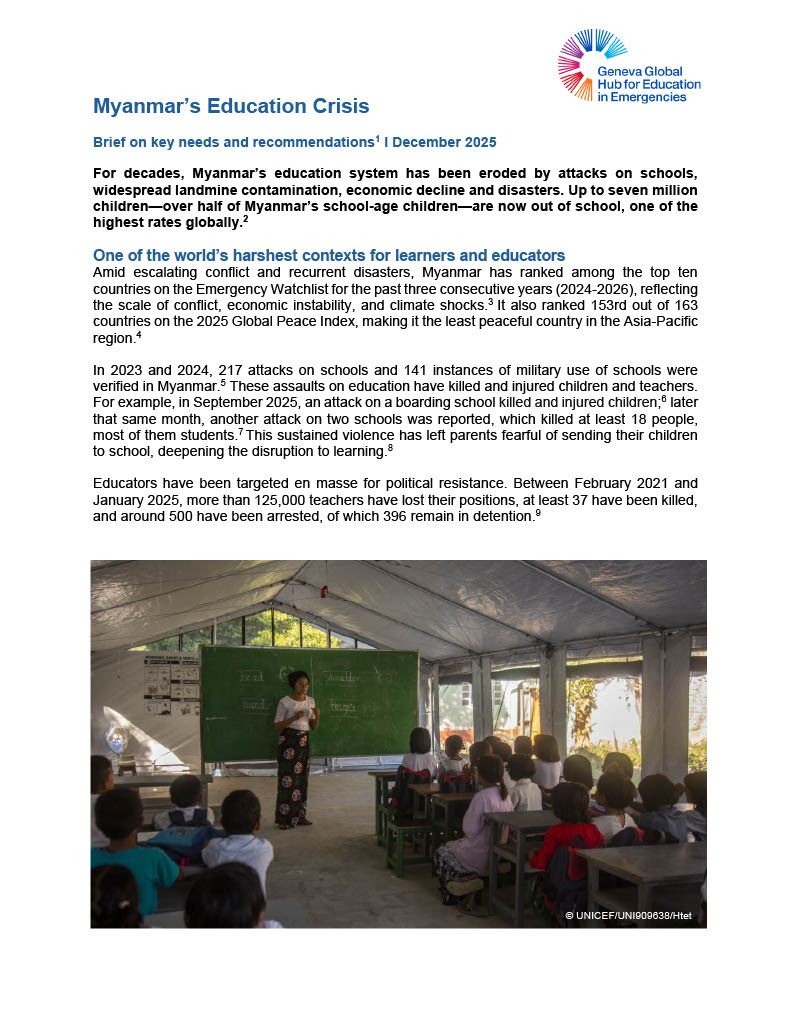
Fund targeted educational programmes and temporary learning spaces for displaced children and youth, with qualified teachers, learning materials, and psychosocial support services.
This brief was compiled by the Geneva Global Hub for Education in Emergencies (EiE Hub)’s Technical Working Group, including representatives of Canada, Education Cannot Wait, the Global Education Cluster, the Geneva Graduate Institute/NORRAG, the Inter-agency Network for Education in Emergencies, Switzerland, UNESCO, UNHCR, UNICEF, the University of Geneva and World Vision International.


